



Frequently bought together
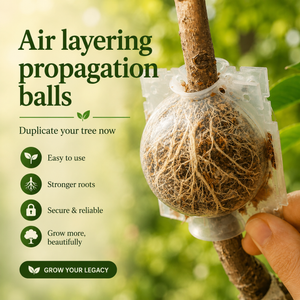

multiply your plants


air layering


with air layering balls?
| Species | Success rate | Rooting time | Notes |
|---|---|---|---|
| Fig tree (Ficus carica) | 6–8 wks | Excellent response, no hormone needed | |
| Guava (Psidium guajava) | 4–8 wks | Very easy, fast results | |
| Mulberry | 4–6 wks | Fast, low maintenance | |
| Pomegranate | 5–8 wks | Very accessible, strong vigor | |
| Loquat (Eriobotrya) | 6–10 wks | Best results in spring | |
| Olive (Olea europaea) | 8–12 wks | Easy in the right season | |
| Lemon / Orange / Citrus | 8–12 wks | Hormone recommended, heat required | |
| Lychee (Litchi chinensis) | 6–10 wks | Preferred method over cuttings | |
| Jackfruit | 8–10 wks | Good response in tropical climates | |
| Mango (Mangifera indica) | 8–12 wks | Ideal for preserving rare varieties |
| Species | Success rate | Rooting time | Notes |
|---|---|---|---|
| Pothos (Epipremnum aureum) | 2–4 wks | The easiest of all | |
| Monstera deliciosa | 2–5 wks | Very fast on aerial nodes | |
| Ficus benjamina / elastica / lyrata | 3–6 wks | Ideal candidates, fast rooting | |
| Dracaena (all varieties) | 3–6 wks | Perfect for rejuvenating overgrown plants | |
| Schefflera arboricola | 4–8 wks | Excellent results | |
| Croton (Codiaeum variegatum) | 4–7 wks | Good response, warmth recommended | |
| Philodendron | 2–4 wks | Late summer or early autumn preferred | |
| Rubber plant (Ficus elastica) | 4–6 wks | Reliable method for leggy plants | |
| Bird of Paradise (Strelitzia reginae) | 4–7 wks | Good results on mature stems | |
| ZZ Plant (Zamioculcas zamiifolia) | 5–8 wks | Tolerant and forgiving species |
| Species | Success rate | Rooting time | Notes |
|---|---|---|---|
| Chinese Elm (Ulmus parvifolia) | 4–8 wks | Popular for bonsai | |
| Ornamental / fruit vine | 4–8 wks | Very good results | |
| Camellia (Camellia japonica) | 8–12 wks | Alternative to difficult cuttings | |
| Hydrangea | 6–8 wks | Retains exact colour | |
| Rose (rare/heritage varieties) | 6–10 wks | Preserves original fragrance | |
| Azalea / Rhododendron | 8–12 wks | Early spring is ideal | |
| Bougainvillea | 6–10 wks | Solid results in warm climates | |
| Magnolia | 8–12 wks | Hormone advised | |
| Lime / Pear | 10–14 wks | Longer but stable results | |
| Oak (Quercus) | 10–16 wks | Variable, spring only |


How long does it take to see roots appear?
Most plants produce visible roots within 3 to 8 weeks. Fast-rooting species like fig trees or Monstera can show results in 2–3 weeks, while harder species like citrus may take up to 12 weeks. Spring and early summer give the best results.
Do I need rooting hormone?
No — it is optional. For easy species like fig trees or Pothos, you can skip it. For harder species like avocado or magnolia, a few drops of IBA rooting hormone on the wound can significantly increase your success rate.
Why are no roots showing after 6 weeks?
The most common causes are an incomplete bark removal (the cambium must be fully exposed), substrate that is too dry, or temperatures below 18°C. Keep the moss consistently moist and be patient — some species need up to 12 weeks.
Can I reuse the ball after the first layering?
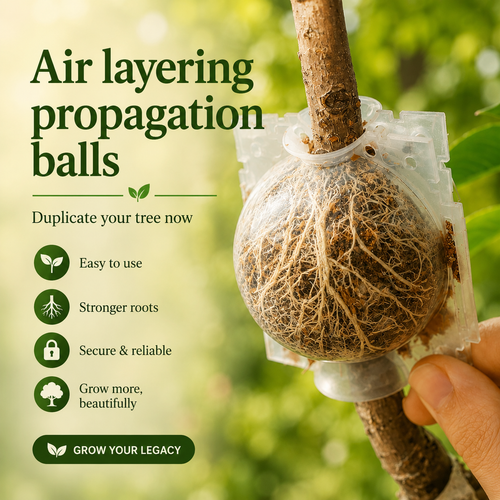
Yes. The balls are made from UV-resistant PP plastic and are fully reusable. Simply open the ball, remove the old substrate, rinse with clean water, and it is ready for the next use across multiple seasons.
How do I repot after separating the branch?
Once roots are visible against the wall, cut the branch just below the ball, open it carefully and repot immediately in a light, well-draining substrate. Keep the new plant out of direct sun for the first two weeks.
Does it work on indoor plants?
Absolutely. The ball works great on Ficus, Monstera, Dracaena, Philodendron and Pothos. It is especially useful for rejuvenating tall or leggy plants by creating a new compact plant from the top section.


